The Real Truth About Working with Recruiters
February 10, 2010 at 6:45 pm 100 comments
[This article was updated in June 2018]
When I first started my career as a recruiter, I worked and trained with a few “old-school” recruiters who had learned the staffing business in the days before internet searches, online job boards or social media … when recruiters were called “Head Hunters” and kept rotating card files called Rolodexes filled with prized contacts next to their wired, land-line desk phones. Their livelihood depended on who they knew – how many “A” candidates they had relationships with and developed trust with. The implication of the term Head Hunter was that they only went after top talent – usually people who worked for their client’s competitors – and actually recruited them away from one company to come work for another! Some of the best of today’s recruiters still operate that way, only seeking out top talent through networking and personal contacts. Many of those old Head Hunters even imagined themselves to be the business world’s equivalent of a Jerry McGuire … like sports or entertainment agents who exclusively represent top talent, shop them around and negotiate the best deals for their candidates. (“Show me the money!!!”) Needless to say, in today’s ultra-challenging, internet-centric job market, most recruiters have learned to adapt to new ways of doing business.
At the other end of the spectrum from the Head Hunters are the younger, much less experienced recruiters who never learned how to creatively “source” (i.e. identify) and then actually recruit (i.e. sell an opportunity to) so-called “passive” (i.e. employed, non-job-seeking) candidates. They only look at résumés from people who respond to their online job postings – active job-seekers, otherwise known as the “low hanging fruit.” Since most companies know how to do the same thing by posting their own ads and collecting those same résumés, recruiters who operate that way are finding fewer and fewer companies willing to pay them a fee for that type of recruiting.
Most modern recruiters fall somewhere in between those two models. As with any profession, there are good recruiters and bad recruiters. Yes, there are recruiters out there who lie, cheat, deceive, bait & switch, promise things they cannot deliver, and will pretty much do or say anything to get a placement and get paid — similar to the stereotype of Used Car Salesmen. I’ve met some of those people, and their sleaze factor can be quite astounding! Unfortunately, similar to the image problem that lawyers have, those bad recruiters tend to give the entire profession a negative reputation. How can you tell the difference between good and bad recruiters? Just like with any other business relationship, time will reveal the traits of a person worth working with: honesty, integrity, sincerely, responsiveness, timely follow-through, etc. Good recruiters treat everyone with respect, and care about the people they work with. They try to do the right thing, and look out for everyone’s best interest – their own, their client’s and their candidate’s.
There are a lot of myths and misconceptions out there about how recruiters work, and how job-seekers can best utilize them as a resource. There is also a lot of confusion among job-seekers about exactly what recruiters do, how they get paid, who they work for, how to approach them, what questions to ask, etc. As a veteran of the staffing industry, I’d like to set the record straight, bust some common myths, and give some advice on how to best utilize recruiters as a resource.
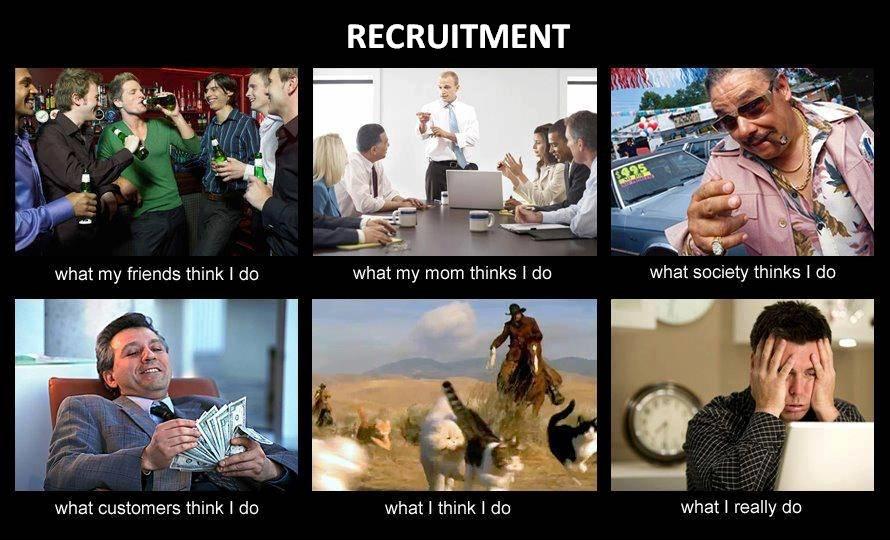
[Click on the image above to expand and see it full-sized.]
The Different Types of Recruiters
Recruiters come in many different flavors. There are Retained Recruiters who typically only work on very specialized high-end C-level positions, and get paid a flat fee for simply producing a certain number of highly qualified candidates – whether or not they get hired. There are “Temporary Staffing” or “Staff Augmentation” Recruiters who work primarily on limited duration contract assignments for their clients and get paid based on their candidates’ hourly billings on an ongoing basis. There are Corporate or Internal Recruiters who work directly for the companies who have the open jobs, and are usually salaried employees of those companies. And then there are 3rd Party Agency Recruiters. For the rest of this article, I’ll focus only on 3rd-Party Agency Recruiters – the ones who work on permanent jobs, usually on a contingency basis. These recruiters work for independent agencies who contract their services to various companies who need help filling open jobs with very specific and often hard-to-find requirements. They search for candidates that match those requirements, and try to present only the top few most qualified candidates to their clients. They are paid on a commission basis if and only if their candidates are hired and after their client company pays their agency’s fee. Those fees are usually a percentage of their candidate’s first year base salary (typically 20-25% – sometimes more, sometimes less.) So naturally it’s in their own best interest, as well as their candidate’s, to help negotiate the highest possible salary from their client during the offer stage. The more the candidate makes, the more the recruiter makes!
Recruiters Are Sales People
I’ve always maintained that recruiting is actually a consultative sales position. In fact, it’s one of the purest forms of sales that you can imagine. It involves selling a complete intangible – something that you can’t touch or feel, but rather a concept. In the case of 3rd-party (agency) recruiting, each deal is actually a series of multiple intangible sales events. First the recruiter has to sell the concept of using the agency’s search services to a potential client company (an employer with open jobs.) Once they get a signed Fee Agreement with that client company, then the recruiter has to actually go out and find — and then sell that company’s job opportunity to — a person who fits the employer’s specific requirements (a qualified candidate.) If the recruiter is successful in “selling” both of those intangibles, the next goal is to get the two parties in a room together (the interview) and hope they like each other. Essentially, it’s then up to the candidate to “sell themselves” to the hiring authority during that interview. At the same time, that hiring authority must “sell their company” to the candidate so that an offer will be accepted. If that results in the candidate getting hired (a placement), and then the client company actually pays their agreed-upon fee to the agency – then and only then does the recruiter get paid! When you consider how many things can go wrong with such a complicated series of intangible sales events, it’s easy to see how difficult a recruiter’s job can be!
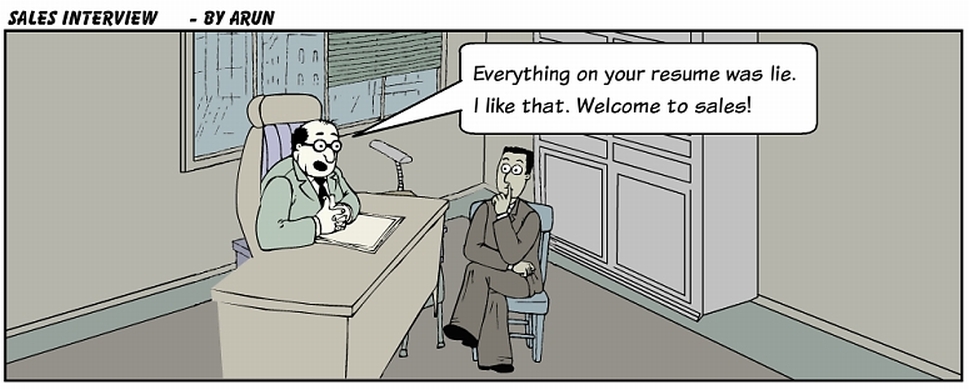
MYTH: Recruiters Find Jobs for People
Wrong! Recruiters find People for Jobs! If you think about it, that’s a very different concept. While a good recruiter will certainly try to do right by their candidates, it’s important to remember that they ultimately work for and get paid by their client companies. Recruiters do not get paid by candidates, nor are they job counselors. Sure, they “counsel” the candidates that they choose to work with, help them refine their résumés, and prep & coach them on interview techniques. However, they are paid by client companies to find candidates to fill very specific positions with very specific (usually hard to find) requirements. Randomly contacting a recruiter with your unsolicited résumé, and saying “can you help me find a job” is NOT a good tactic … and most recruiters will not respond. I get at least two or three of those a week from people I cannot possibly help. On the other hand, answering a recruiter’s job posting with your résumé and a message that says “I match every requirement you’ve listed …” is a GOOD idea. Calling to follow-up is even better. The name of the game is matching your skills and experience to a specific job they are already working on. That’s what they get paid for! That’s why most recruiters don’t return calls or emails from candidates that don’t match all the requirements of their current job searches. For them, time is money, and they only make money on matches!
Is it Better to Apply Directly to a Company, or Go Through a Recruiter?
The answer depends on who you know at the company. If you’ve already networked your way to a decision-maker, and have a personal relationship there … go direct! If, on the other hand, you don’t know anyone there and you talk with a recruiter who has a personal relationship with a hiring manager … then the advantage goes to the recruiter! The company’s desire to avoid paying the recruiter’s fee might sometimes be a factor … but a personal relationship trumps that every time. Most good recruiters develop and nurture relationships with their clients over a long period of time. Those relationships are invaluable … they have the trust and attention of the decision-makers who are the hardest to reach. They can get you in front of the right people. That is one of the main advantages of using a good recruiter!
Industry-Specific Recruiters
Most Recruiters specialize in a specific industry, and only look for specific types of candidates. Some are more focused than others. For example, a recruiter may be a general IT Recruiter, looking for any and all technical positions. Others may be focused on a smaller subset of IT – for example, only .NET programmers, or only JAVA developers, or only Web Designers, or only users of a particular type of software, etc. Others may focus on totally different industries. I’ve heard of Recruiting Firms that concentrate exclusively on very narrow industry specialties: HVAC Engineers, Paper and Pulp Industry Professionals, Hospitality Industry Executives, Copyright Lawyers, Chief Financial Officers, Radiology Technicians … the list is literally endless. Needless to say, an industry-specific recruiter does not want to waste their time talking to candidates who do not fit their niche. Job-Seekers who want to find a recruiter to work with should figure out which agencies and/or recruiters specialize in their specific industry niche, and focus on getting on their radar.

How Do Recruiters Find Candidates that Match Their Job Requirements?
There are several ways that recruiters might find matching candidates: using sophisticated Boolean key-word searches, they first mine their electronic resources: they look in their own data base of collected résumés; they post their jobs (usually without identifying the client company) on the popular job boards, on Social Media sites, and on their own agency’s website and then screen applicants for matches; they search résumé banks that they pay to subscribe to, like CareerBuilder, Monster, Dice, etc.; they make extensive use of searches on all the Social Media sites like LinkedIn (which has now become the Number 1 search tool recruiters), Facebook, Twitter, etc., and send messages to people they find that potentially match the requirements they are looking for. Finally, they do a LOT of old fashioned cold calling to people within their industry niche, asking everyone if they know of anyone else that fits their job requirements, and asking everyone they talk with for referrals. It’s a laborious time-consuming process where one person leads to another, to another, to another and so on. All along the way they collect résumés from potential candidates who may or may not fit the immediate job they are working on, but seem worth keeping on file for future searches in their specialty area.
What is the Best Way for a Job-Seeker to Use Recruiters as a Resource?
Try to identify an agency, or a specific recruiter who specializes in your industry niche, and put yourself “on file” there. Send them your résumé to get into their searchable electronic data base so that when a new job comes up, they’ll “find” you later during a future search. You should also regularly check that niche agency’s job posting on their own website, and look for jobs that match your background. If you do spot a matching job, contact the agency and ask which recruiter in their office is working on that search … and try to reach that specific person to alert them of your own matching qualifications. Needless to say, you should also keep your online profiles (LinkedIn, Monster, CareerBuilder, Dice, etc.) up to date and filled with as many “keywords” in your niche as possible. You want to make yourself “find-able” when a recruiter does a search for someone with your skills and experience.
What Questions Should You Ask of a Recruiter Who Calls You About a Job?
► What company are they recruiting for? (If you’ve already applied directly to that same company or been called by another recruiter for the same position, they would probably not be able to represent you there.) Find out everything the recruiter knows about that company. If they cannot tell you the name of the company, ask why. (If it’s truly a “confidential” search, OK … but more often than not it’s a trust issue, and failure to identify the client could be a red flag for a job-seeker.)
► What are the job requirements? Ask them to send you a job description. Help the recruiter see how you fit those requirements, if you do. Be honest about any requirements that you really don’t have.
► What is the salary range defined for the position? You should be honest and up front about your own salary history and the salary range you would accept going forward. If your salary history and expectations do not match the job’s defined range (or seem unrealistic) most recruiters will not consider it a match worth pursuing. Like it or not, it’s a primary factor recruiters use to decide who they’ll represent to their clients. [Read “Answering the Dreaded Salary Question” for more info on how to deal with this issue when working with recruiters.]
► What is the history of this position? (New or replacement … and if the latter, what happened to the person who left?)
► Who is the hiring manager, and how well does the recruiter know that person? What is their management style? What is the company culture like? Can you get any inside intelligence?
► How many other candidates is this recruiter representing to this job? Are there other agencies that are also sending candidates, or is this an “exclusive?”
► What is the client’s hiring timetable? What steps are there – how many phone interviews and in-person interviews will there be, and with whom? When do they want someone to start? How long has this position been open? How high is their degree of “urgency” to full it?
► What is the next step? Will the recruiter definitely be sending your information to the client – and if so, when? How soon should you expect to hear back from the recruiter?
Good recruiters should be able to answer almost all of these questions and more. If they can’t answer those basic questions … then they probably don’t know their clients very well, and I would question whether or not you want them to represent you. Good recruiters will also be able to help you tweak your résumé to better fit the job specs, prep and coach you on how to successfully interview using their insider knowledge of the company and the decision-makers, and they will help you negotiate the best salary if and when an offer comes. Good recruiters will also follow through with things they say they will do, and will be good about keeping you informed with updates and progress reports. Expect good communication … and beware of anyone who suddenly stops returning your calls or emails — that’s a telltale sign of unprofessionalism that is certainly not limited to recruiters!
Also, always verify that the recruiter will never submit your résumé to any companies or jobs without your knowledge and approval. Believe it or not, that happens quite frequently. I’ve recruited many candidates over the years who swore they never even heard of my client company, only to find out later that the company had already received that person’s résumé from another recruiter! Not only did that make me look stupid, but more importantly it ruined that candidate’s chances of getting the job – most companies will automatically eliminate any candidate who is submitted from multiple sources. They don’t want to get into the middle of a turf war.
What NOT To Do When Working With Recruiters …
► Never ever agree to pay any money to a recruiting agency for their services, or agree to any future financial obligations – e.g. re-paying their fees if you leave a job before their guarantee period is up. Recruiters who ask for money from candidates are not to be trusted. Run away quickly, and don’t look back!
► Never do an “end-run” around a recruiter and apply directly to a job they told you about. That is extremely unethical, and almost never ends well. If, on the other hand, the recruiter does not submit you to their client company for whatever reason – then you have every right to go ahead and apply directly to that company on your own.
► Do not sign any documents that promise “exclusive representation” by a recruiter (except specifically for the one position/company they are working with you on.) You have every right to work with multiple recruiters (as long as they are not working on the same job with the same company) and to continue applying directly to other companies. You should, however, inform your recruiter of other opportunities you are working on – especially if you are actually interviewing elsewhere, and may be getting close to an offer at another company.
► Never lie to a recruiter about your qualifications, your experiences, your education, your salary history, or anything else! Be honest about everything, and expect the same in return.
► Finally, do not put all of your job hopes into working with any recruiter, no matter how good they are. The real truth about working with recruiters is that while they can be a great resource … the vast majority of job-seekers today will NOT find their next job through a recruiter. Job-Seekers should concentrate on their own networking activities designed to get them in front of decision-makers in their target companies. [Read “How to Network: A Step-by-Step Guide for Job-Searching” for more detailed information on how to do exactly that!]
Entry filed under: Advice for Job Seekers. Tags: consultative sales, job-seekers, networking, Recruiters, unemployment.
100 Comments Add your own
Leave a comment
Trackback this post | Subscribe to the comments via RSS Feed



 Recruiter Musings
1. Eddie | February 11, 2010 at 4:10 am
I find the content amusing and very insightful while at the same time intriguing. Most are already aware that recruiters help prospective candidates “brand” ourselves to maximize our leverage so as to land an interview which can potentially lead to a job offer. It has become very crucial to work “hand-in-hand” with these professionals to tap onto their network & credibility in the market place so as to extend & expand the reach candidates can gain with potential employers.
2. Mary J. | February 11, 2010 at 2:13 pm
I read lots on recruiters and seen them on sites. I myself, wouldn’t use one. I don’t know of anybody who’s gotten employed thru one yet.
3. Recruiters are a joke | January 7, 2015 at 11:04 am
They are pretty much a joke, just looking to make a quick buck and pawn you off to the first person who will take you.
4. Michael Spiro | January 7, 2015 at 12:49 pm
It sounds like you’ve both had dealings with some lousy recruiters. That’s unfortunate. As I said in the blog, there are good recruiters and bad recruiters. Yes, some will pretty much do or say anything to get a placement and get paid. Unfortunately, those bad recruiters tend to give the entire profession a poor reputation. However, you should not be so quick to condemn an entire group based on a few bad apples. Such negative stereotyping will not serve you well in your future job searches.
5. Jim Gill | February 11, 2010 at 4:18 pm
Amen!
Thank you for reiterating and supporting what we tell our clients and candidates every day!
Thanks Michael!
6. Rhonda Skalsky | February 11, 2010 at 5:54 pm
Hi Mike,
Have you ever thought about writing a book? These blogs are so thorough, thought provoking and informative.
Thanks fo much!
7. Katherine moody | February 11, 2010 at 6:43 pm
This is a great post–comprehensive and lots of good points that are important for candidates to know.
If the search is with a retained recruiter, even if the candidate goes to a contact in the company, almost always the retained recruiter will be asked to work with that candidate. That way every candidate knows they have been through the same process. In 14 years of retained search, it never bothers me if a candidate uses other means to come to the attention of the company. Especially if it’s an employee referral–always a good thing.
If the external recruiter is a contingency recruiter, the company probably will not pass on any resumes that come to them directly. So that candidate has an advantage because they do not have a commission attached to their candidacy. Not nice to use the contingency recruiter to find out about the job and then go around them, however.
I think this is a great blog for job seekers and one worth spending some time on.
8. Frederica Bolgouras | February 11, 2010 at 6:56 pm
Hi Mike,
You so right on all counts! Your work gives a clear picture to all who are seeking new opportunities and an understanding of the search world. Today, everyone is responsible for their own search. Recruiters do work for the client and many times candidates don’t understand that and want special attention. I always extend myself as they could become clients of mine some day and the point is to establish a good business relationship. Many times though, candidates try to push too hard or could ask inappropriate questions to score points. They are trying to “get in’ and stay close. It is important to always be professional and never compromise your integrity. Our searches were always confidential.
Thanks for the good read.
Best,
Frederica
9. Phil Rosenberg | February 11, 2010 at 7:23 pm
Nice article Mike!
Your readers might find this article I wrote a while back about how to effectively work with recruiters, remembering the cardinal rule of recruiters – They work for the hiring manager, not the candidate… and a recruiter’s job isn’t to call you back.
See how you can make these rules work for you (rather than against you) at: http://recareered.blogspot.com/2008/02/inside-track-on-recruiters-top-10-tips.html
10. David Bisignani | February 11, 2010 at 8:23 pm
Thank you for taking the time to write your blog. I enjoy reading it and have learned quite a bit from it! I look forward to each new post! Keep the good tips coming!
11. RW Carsia | February 11, 2010 at 8:27 pm
This guy is so pragmatic, I can laugh through the pain of reading his stuff. Most of it is trueeeeeee and truer.
12. Eric | February 11, 2010 at 9:26 pm
As always, very insightful. I appreciate your candor, and your very topical discussions.
13. Steven Katz | February 12, 2010 at 1:34 pm
I agree with Michael. Recruiters do what is needed to get the person an interview. Most candidates don’t know how to write a resume or use the right “Buzz Words” to stir interest. Most don’t even know about “spell check” so it is our job to make sure all resume look good and hit the mark (without spelling mistakes). If I sent out the resume I received, I probably wouldn’t get as many interviews as I do. What I see that recruiters don’t do enough (which I train all recruiters to do) is once an interview is set-that’s when we really earn our keep by preparing them 100% for the interview-not just the address-who to speak with and a slap on the back-good luck! We should be experts on how to interview and how you handle yourself during that interview and the follow-up. The Interview is one of four steps in looking and getting a job. Resume, Interview, Prep and follow-up (close) are those 4.
14. Amelia R | February 12, 2010 at 2:10 pm
Hi Mike – great stuff, thanks for sharing.
I am in a situation where I responded to a recruiter’s posting & was told that I was not a good fit for an interview. A month later I responded to a posting on a Right Management job alert & I have a face-to-face later today. I have found out that the hiring manager will be meeting with the recruiter’s candidates beforehand – which according to the recruiter, I was not a good fit. Now, I had no way of knowing that this way all about the same job because the recruiter did not disclose what company he was representing.
Interesting …
15. Georg Toecker | February 12, 2010 at 3:47 pm
I do agree, as I ask recruiters all the time to review my resume before submitting and if they want me to make changes to it, I will, or if they want to make the changes, go ahead just send me a copy of it prior to the interview so I’m not suprised by something entirely different then what I wrote.
16. Georg Toecker | February 12, 2010 at 3:51 pm
I like Michael’s way of using 3rd party recruiters. I used to take it personally when they didn’t call you back or you called and they didn’t take your call….but since I was laid off from Accountemps I have been working with temporary and 3rd party recruiters I do hear from them if there is a close match and since in my career I have done so many things I may have actually done something that gets me in the running that wasn’t on my original resume, had they not called and asked me if I had done this or that, as I had 95% of the other requirements.
17. Gretchen Gunn | February 12, 2010 at 4:38 pm
Well said. It’s as though I read your blog before a I spoke this morning at a business group networking meeting. Reading your post when I got back to my desk reassured me that not only is this information topical, it will help promote equal business status and a better partnership among good staffing specialists and their clients which I believe are both employers and those seeking employment.
18. Steve G | February 13, 2010 at 8:37 pm
Well written and spot on! Wish I had known this when I first started working with recruiters, head-hunters, etc.
19. Leah Rosen | February 15, 2010 at 7:19 am
I read your blog post..good information. The bottom line is that developing a relationship with a recruiter is like anything else in your career. Some are good, some are bad. It’s a question of the work and follow up you put into the relationship. If they are bad, move on…if good, work with them and keep in touch after they place you. That’s key!
20. Ruth Rivers | February 17, 2010 at 1:16 pm
Michael- you always tell like it is… Thanks
21. Tom Crowley | February 17, 2010 at 3:00 pm
Good overview and insights, Thanks for sharing! I am in the job Market for the first time in 20 years and the new rules of the electronic age of job seeking have created a whole new game. The challenge from my perspective is to find and partner with good recruiters who have the reputation and contacts in my field (Building materials/construction) and who also have enough of these contacts to cover a meaningful portion of the job market
22. Michael Rivard | February 18, 2010 at 7:52 am
Thank you!!! Excellent resources and as someone who has entered this unemployed arena, I certainly appreciate the insight on how to understand and leverage relationships with recruiters.
Mike Rivard
Sales Leader Now Available
23. Jennie | February 18, 2010 at 12:47 pm
These are all great tips. Of course recruiters are working for those hiring! I guess I have been fortunate that the recruiters that I am working with do call me back or e-mail me. I have gotten some great feedback from my recruiters. Do I have a job…..no. But, at least the responsiveness of my contacts gives me hope.
24. Ercelle | February 22, 2010 at 4:42 pm
This is a great article that answers many of my questions about working with recruiters. Straightforward, well-stated and very helpful. Thank you for sharing this information. In the current climate of unemployment, I am sure that many will benefit.
25. Tim Krenn | February 23, 2010 at 10:01 am
Great article. I think that many job seekers don’t understand the full role of a recruiter. How they are compensated, what is their niche, and how are they being compensated for their search, are very important things to understand when reaching out to a recruiter. My favorite take-away from this article is to include within the cover letter that “I match every requirement that was listed…” How many times have I written the same basic cover letter with only changing the company and contact?? Too many times!! Great article and I will definitely follow your blogs moving forward.
26. Anjali | February 23, 2010 at 10:29 am
Mike,
Very objective information on the pros and cons of working with recruiters.
Good tips to keep in mind in dealing with all types of recruiters.
Thanks.
27. Bob Jackson | April 20, 2010 at 8:28 pm
2007: Optimism has been replaced by Hope.
2008: Hope has been replaced by reality.
2009: Reality has been replaced by frustration.
2010: Frustration has been replaced by anger.
We all need to be careful with whom and with the way we express ourselves
28. Margaret Neville | April 21, 2010 at 11:30 am
I find Michael to be right on! His comments are always presented in a positive format. His information is very supportive and encouraging for those seeking employment and self empowerment! Thanks Michael for caring about us!
29. Aaron | January 10, 2012 at 11:47 am
Great article, Michael! I had a follow-up question. If a recruiter represents you and the employer decides they aren’t interested, at that point, is it acceptable to contact the company directly? I had a situation where the recruiter told me my salary demands were to high. I relented and let the recruiter know I was willing to accept a lower salary, but she indicated that she was not going to inform the employer even though I was willing to be flexible on salary. What would be the best way to handle this situation?
30. Michael Spiro | January 10, 2012 at 12:43 pm
Hi Aaron: Great question. The quick answer to your question is inform the recruiter who represented you. It’s best to let them know that you intend to contact her client directly before you potentially step on any toes or “blind-side” her. The recruiter’s refusal to pass along your willingness to be flexible on salary is curious. Several scenarios are possible. Perhaps there were other reasons they rejected you, and price was just the “excuse” they used. Perhaps the recruiter had another, stronger candidate who was closer to being hired, and she didn’t want to muddy things up by dropping your price. Perhaps the recruiter didn’t want to accept a lower fee (which is usually a percentage of your salary.) Or perhaps the recruiter didn’t want to put out the perception that you were desperate by changing your salary requirements after the fact. Once you state your salary requirements, it’s best to stick to your minimum. Also, knowing that you “relented” might make you seem like a risky placement who would be unhappy with the lower salary and be a risk for bolting if a better offer came along.
The question this raises for me is why would you want to contact a company that already said they were not interested in you? (It’s rarely just about money.) Doing so could not only potentially embarrass the recruiter who has the relationship with the hiring authority … but could also potentially make you look even worse to that company by being an annoying pest. You might be thinking “what have I go to lose, since they already rejected me?” Well, you’d be surprised. I’ve had candidates “go rouge” on me by doing just what you are suggesting. One even got to the face-to-face interview stage before being rejected. That guy thought he’d aced the interview and just couldn’t believe they were passing on him! He decided to contact the interviewer directly and plead for another chance! The result was that hiring authority called me (as the recruiter) and basically said “why is your candidate continuing to contact me after I already told you I was not interested? Tell him to lay off!” There’s no way they’d ever consider that guy for future positions after that behavior.
I suppose there might be a case where you don’t trust that the recruiter represented you properly (or at all) … and you want to contact the company yourself to verify that they did, indeed, consider you. That’s a long shot — but if that’s your reason, at least it’s understandable. There also may be a company that is so large that you are only being seen by one small department, and you want to contact someone in a totally different area. Again, more understandable. I still have to wonder, though, why you don’t just take no for an answer and move on to other more promising target opportunities.
Just my 2 cents.
31. Chloe | January 13, 2012 at 7:59 am
You comment about not submitting an job application to the company that a recruiter brings to you. I am in a field that is narrow with only a few employer prospects in my professional and geographic community. After learning that my employer is closing its doors, I submitted resumes and created profiles with most of these companies. Within the past 6 months, I have applied for a job similar to the one the recruiter is looking to fill. I am a perfect candidate and meet all the criteria for the position the recruiter has and I have not applied for this specific job directly. The recruiter stopped all communication with me after submitting my profile and learning that I had applied for a similar job with the same company. If I go around the recruiter, and apply directly to the company I tarnish my relationship with the recruiter and it is unlikely that my application will receive the same attention. I feel screwed. I am willing to do whatever to get in front of the hiring manager. I would consider paying a finder fee to the recruiter.Is this wrong in this case? Are there alternatives?
32. Michael Spiro | January 13, 2012 at 9:57 am
Chloe: If the recruiter has, indeed, stopped all communication with you … then I don’t think you need to worry about “tarnishing your relationship” with that person. It sounds like there is no relationship to tarnish! Your only alternative is to continue to pursue that job at your target company directly. You need to find another way to get to the hiring manager besides through the recruiter. My guess is that the recruiter learned that he/she will not get paid a fee for submitting you since your resume was already on file with that company’s HR people. That recruiter is more likely to make money by placing someone else there if you DON’T pursue the job on your own. That’s probably why they are not communicating with you. (Do NOT offer to pay any recruiter a “finder’s fee” — that would not even come close to the amount they might collect from a placement fee paid by the company — and there would still be no guarantee that you’d even get an interview, much less the actual job.)
33. Robbie | March 19, 2012 at 6:10 pm
Glad I found this site-good stuff Michael.
To those high caliber recruiting professionals reading the blog, forgive me for saying so but the reputation and sentiment of others I talk to seems that recruiters in today’s market leave much to be desired. I’m not sure how he does it but recently one of my colleagues told me he is refusing to work with them-seems to me that often times you have little choice-I have to assume he is passing up opportunities?
Michael, my question…is there such a thing as a blacklist that a job seeker could be placed on in the recruiting world?
34. Michael Spiro | March 19, 2012 at 6:16 pm
Robbie:
Nothing official … but it’s certainly possible to become known as someone that recruiters do not wish to work with — especially within a particular agency. Here’s a story from another blog article of mine: “I still remember a particular candidate a couple of years ago who was unhappy with the responses he was getting from one of my colleagues at the recruiting firm we worked for. He sent a long, nasty, ranting email to that recruiter, which culminated in him calling him an “asshat.” That term was so unusual, and so funny sounding … well, most of us in the office had never actually heard it before! That email was eventually forwarded over and over and over to almost every one of the hundreds of recruiters who worked at our firm across the country. His name became notorious as “the asshat guy” who no one would ever want to work with. Needless to say, that candidate was never considered for any future positions we worked on.”
-Michael
35. Michael Spiro | June 25, 2012 at 11:36 am
The following comment, my reply to it, and the dialogue back and forth were posted to a different blog article on Recruiter Musings (“Top 10 Most Annoying Things for Job-Seekers.”) I decided to copy them here also because they seemed to fit this blog’s topic better:
Scott Wagner | June 24, 2012 at 7:42 pm
I have a technical skillset that is in high demand. Due to this, I receive dozens of phone calls, mostly “cold calls,” a day from recruiters who insist that I repeat information that is already in my resume before even telling me what the position is and where.
Some serious complaints about recruiters:
– If you leave a message saying “I think I have a position you might be perfect for, please call me back,” I’m not going to call you back. Tell me what the position is or lose out.
– If you low-ball me, I’m going to find out and you’re going to lose out.
– Setting up an interview does not constitute a long-standing business relationship. If I decide to no longer pursue the company, suck it up. Be prepared with other candidates and don’t lecture me, I’ve been doing this for a long long time.
– Don’t leave another voicemail asking me why I’m ignoring you. Move on.
– Not everyone is desperate for work, and not all people have the same career goals. In the case of IT, not everyone is trying to clear six-figures and not everyone is trying to work for Google or Microsoft. Some of us want flexibility, etc. Don’t go into a conversation assuming all candidates are the same.
– Only a fool would reveal salary and allow an employer to base your pay on your history. No role is the same, no workload is the same, no environment is the same. Asking rate changes.
– If you haven’t actually worked in the field before, particularly to the degree your candidate has, again….. do not lecture them on “professionalism” or “the way (whatever their trade is) works.” We are money in your pocket, treat our hard earned experience with respect. This behavior is obnoxious and only serves to make you seem incompetent.
To the eyes of a candidate, recruiters are in the way and money out of our pockets. It is not an honor to talk to recruiters. If the company didn’t need the candidate’s help, you wouldn’t be calling.
MY FIRST REPLY:
Michael Spiro | June 25, 2012 at 11:20 am
Scott:
Your angry tirade against recruiters is both amazing and revealing. It must be wonderful to be so in-demand and sought-after, and to be able to pick and choose your opportunities in today’s challenging economic times. What comes through loud and clear in your comments is a profound attitude of entitlement and a holier-than-thou, self-centered egotistic narcissism. You are quite the Prima Donna! Wow — dozens of calls a day from money-driven, obnoxious and incompetent recruiters, eh? The nerve of those peons chasing after you! You’re certainly no fool. In fact, clearly you are better than everyone else and should not waste your time dealing with all those bottom-feeding, unprofessional sycophants. Obviously they need you more than you need them.
Over the years, I’ve occasionally encountered highly talented candidates with in-demand skills that sound very much like you. What I’ve learned from trying to deal with them (and this is a universal truth — not just a staffing thing) is that attitude far outweighs skills in the real world … and after reading what you’ve written, my instinct would be to NEVER represent anyone with an attitude like yours. I hope for your sake that you don’t ever find yourself in the shoes of so many of the highly talented professionals I see who struggle to find work and really do need good recruiters to help them with their job searches.
Good luck,
Michael
HIS RESPONSE:
Scott Wagner | July 21, 2012 at 9:03 pm
Michael,
I’m not angry, I’m stating facts from the candidate point of view for recruiters to take note of.
You are correct, I do need good recruiters, and I do have good recruiters and I take every step to ensure we maintain a good relationship. Unfortunately I am inundated with a new recruiting industry full of recent (insert liberal arts degree here) grads, fly-by-night call centers who read off a script and flood me with computer-dialed cold calls, and people who just want to take me to lunch regardless of my interest (I’m assuming this checks off a “keep my job” or “bonus!” box somewhere.)
I’d imagine by the depth of your site that you are a good recruiter, but your type is few and far between these days in my industry.
Scott.
MY SECOND REPLY:
Michael Spiro | July 23, 2012 at 2:31 pm
Scott:
It works both ways. As a recruiter, I’m on the receiving end of frequent calls and emails from job-seekers — many of whom have no clue what recruiters do or how they work, and often have minimal marketable skills, terrible resumes and poor communication skills. However, unlike you, I always try to be professional and courteous to those callers, and treat them all with some degree of respect and dignity. I have sympathy for anyone in a position where they have to cold-call lists of people begging for help — I’ve been there and done that, and believe me when I say it is no fun at all! The Golden Rule applies to all of these situations — both yours and mine. What goes around comes around.
Michael
36. K | August 22, 2012 at 5:07 pm
I found a job on my own before my staffing firm was able to. When they called me about a position they were working on, I informed them I found something. They asked me what company I will be working for? Why do recruiters ask this personal piece of information? What do they do with it? I’ve had two different recruiters ask me this.
37. Michael Spiro | August 22, 2012 at 5:33 pm
That’s a good question … and the answer is fairly straightforward. In general, recruiters want to know which companies are hiring, and where they are. It’s part of gaining an overall understanding of the current business climate in different industries and locations. And obviously, they want to know which companies to target for potential business development (i.e.“I understand that your company is hiring right now … perhaps you could use the services of my recruiting firm to source some great candidates for some of your hard-to-fill positions!”) It’s the same reason recruiters scan job boards and company websites looking for open job opportunities — they want to know who is hiring, and who might need their recruiting services.
-Michael
38. K | August 22, 2012 at 5:42 pm
Ahhh! That eases my mind a little. Lol. Thanks!
39. Robert, Phoenix, Arizona | August 22, 2012 at 5:32 pm
I accomplish a lot of Interim CXO work for early-stage companies, plus I’ve done management consulting for over 20 years. Most of my contacts come from investors or VCs. Recruiters haven’t entered my picture for those 20 years. When they do call, it’s generally for a lower level position, totally appropriate for a 30-something. I’m not 30 anymore:)
40. Michael Spiro | August 22, 2012 at 5:52 pm
Robert:
You are lucky to have such a strong network! Most independent consultants struggle with their own business development activities. I work with a lot of “senior-level” consultants, and the most common complaint I hear is that they love actually doing the work, but they hate the part where they have to sell themselves. Referrals from your own network are always the best way to sustain a business. Best of luck!
-Michael
41. Robert, Phoenix, Arizona | August 22, 2012 at 5:58 pm
Luckily Michael, I actually have a staff of 5 people working from home. It’s been a trying time over the last few years, but I work in 10 different verticals globally, so the impact is minimized. I’m just over 60, so my ‘headhunter call’ days were over 10 years ago. The new 65 is 50, as a recruiter told me recently. That’s a fact, unless you control your own destiny. I started doing that 20 years ago. Today, it would be a real challenge, and recruiters would not play a role in it.
In fact, the last position I got was from Korn-Ferry (they still around) in 1987! Seems like yesterday…but the pay was good, and they moved me to Los Angeles from Houston….for free, and bought the house. Now…that’s a ‘head hunter’! Stay well.
42. Ken Sundheim | November 26, 2012 at 4:18 am
This is very pertinent information with regards to working with recruiters. I think that job seekers and employers alike can benefit from this.
While using recruiters can be a great tool, I do suggest that most job seekers find other recruiting avenues as well.
43. Lisa Gallant-Brampton,Ontario | January 11, 2013 at 12:31 am
The agencies suck.could care less about anyone. A lot of things need to change-we all have a right to have jobs.,not be labelled as a number,discriminated cause of our age,attitudes need to change-for the better.,batter pay so we can all live better.,no matter what type of job it is.
44. Michael Spiro | January 11, 2013 at 9:03 am
Lisa:
Based on your use of crude language, poor grammar and the bad spelling in your comment (“batter pay”) I’m not surprised that you are not having success finding a job. Any recruiter, HR person or hiring manager who reads what you’ve written here would probably not view you as a candidate worth considering for any job. And no, we do not all have a “right to have jobs.” First you must be qualified, and then you need to effectively communicate and sell yourself to a hiring authority. There are good agencies and bad agencies out there. Lumping them all together, or blaming them for your own lack of success instead of working on improving your presentation will not help you in any way.
-Michael
45. V | January 31, 2013 at 10:32 pm
I have actually had lots of success with agencies, and I recommend them to my friends and family when they are job searching. I’m working for an agency now on a temp-to-perm assignment and yesterday my “agent” actually contacted me and offered me an opportunity to work for him! This agency is one of the larger ones. They are international. It seems like an interesting opportunity too, but I’ve never done sales. I’m an accountant, so I would work in the accounting and finance division. Can you offer any advice on what to expect when working in this field? I have two opportunites to chose from at the moment and need to make a decision over the weekend. The recruiting firm would be a career change and the accounting position would push me forward on my current path. Any info you have is greatly appreciated.
46. Michael Spiro | February 1, 2013 at 10:38 pm
To properly describe the pros and cons of a career as a recruiter would take up WAY more space than I can devote to that topic in this short reply to your comment. Suffice it to say, it is SALES — pure and simple. Here’s an exerpt from a blog I wrote a while back: “Recruiting is one of the purest forms of sales that you can imagine. It involves selling a complete intangible – something that you can’t touch or feel, but rather a concept. In the case of 3rd-party (agency) recruiting, it’s actually selling two different intangibles. First the recruiter has to sell the concept of using the agency’s search services to a potential client company (an employer with open jobs.) Then the recruiter has to sell that company’s job opportunity to a person who fits the employer’s specific qualifications (the candidate.) If the recruiter is successful in “selling” both of those intangibles, the goal is to get the two parties in a room together (the interview) and hope they like each other. Essentially, it’s then up to the candidate to “sell themselves” to the hiring authority during that interview. If that results in the candidate getting hired (a placement), then and only then does the recruiter get paid! When you consider how many things can go wrong with such a complicated series of intangible sales events, it’s easy to see how difficult a recruiter’s job can be!”
You must be comfortable in a sales role in order to succeed as a recruiter. There’s an extremely high turnover rate in the staffing industry. Many more people try it and give up and/or fail than there are success stories. I guess it’s actually harder than it appears to be for most. It’s a classic case of high risk, high reward. If your good at it (and that’s a big “if”) you can make as much money as a doctor or a lawyer — with literally no special educational background or formal training. But if you’re not so good at it … well, you’ll starve. I hope that’s helpful information.
47. http://www.servicemaster.com | July 16, 2013 at 10:12 am
Appreciating the time and energy you put into your site and in depth information you present. It’s awesome to come across a blog every once in a while that isn’t
the same outdated rehashed material. Wonderful read! I’ve saved your site and I’m adding your RSS feeds to my Google account.
48. Chris Armour | September 13, 2013 at 1:10 pm
I was skeptical when I saw the title of this article, but Michael is spot-on in his assessment and advice for working with a recruiter. Understanding how the recruiting industry works, and what recruiters can and cannot do for you as a job seeker is key to a successful recruiting experience. Nice job Michael.
49. Just Curious | September 27, 2013 at 8:28 pm
Hello,
Michael, I recently had an encounter with a recruiter for the first time and the experience left me feeling a little bit foggy in general. I submitted for a position for which I have experience and I thoroughly enjoyed the previous job. I am currently employed, but I find myself wishing for a job like my previous one! (I had to relocate with family which is the only reason I left this job). Anyways, I was contacted and complimented for my resume and my communication skills, beyond that an interview was scheduled. The recruiter had been hired by the company, and I was expecting a direct hire situation, but didn’t mind the 3rd party aspect. The recruiter said they would call me before the interview and also “try” to meet me there. Unfortunately both things did not happen – also, okay with me. The initial interview was with the hiring manager, it was successful and I was immediately asked for a second interview. Upon my second interview, I met the recruiter… I thought the meeting was for all intense and purposes a good one, with only minor areas that I could have approached better. All and all, I found the recruiter has continued their search for candidates without ever following up with me. I took the hint that I was not selected… Anyways, the whole thing was a little bizarre, is this a typical experience?
Also, I wanted to compliment your ability and willingness to reply to the comments. I find all of this both insightful, and interesting!
50. Michael Spiro | October 1, 2013 at 11:59 am
Just Curious:
I can’t say the yours was a “typical” experience … but I’ve certainly see such things happen. Personally, I always try to get back to any candidate I’m working with and give feedback after interviews — even if it’s negative — sometimes just to put closure on things. Unfortunately, some recruiters (and also hiring managers from companies) will just “go dark” on someone when they realize that there is not a fit. I guess they think it’s easier to ignore someone than to deliver potentially unpleasant news. It’s frustrating, I know … but just part of the hiring landscape in our world today. If for some reason you did get eliminated after those interviews, and the recruiter simply chose not to tell you, all you can do is try to contact that recruiter directly and ask point blank if you are no longer in consideration. If don’t get a reply, then just chalk it up to a lack of professionalism and move on.
Michael
51. Cautious | February 19, 2014 at 3:16 pm
Hi Mike, you wrote: “If, on the other hand, the recruiter does not submit you to their client company for whatever reason – then you have every right to go ahead and apply directly to that company on your own.”
BUT– couldn’t there be a downside to doing this? Or do I have nothing to lose? In my case it was a national search that’s been open for six months, and the job is still not filled. I was turned down by the recruiter after he interviewed me. It was all very professional and amicable; I just didn’t make the cut. Couldn’t that be bad for my reputation if the recruiter found out I applied to the company on my own?
52. Michael Spiro | February 19, 2014 at 6:13 pm
Cautious:
If the recruiter that turned you down was a 3rd party recruiter — that is, not an employee of the client company — then you absolutely have every right to apply directly to that client company now. That’s really the only way the client will have a chance to review your resume at this point. If you are really worried about your reputation with that 3rd party recruiter, you could inform him/her of your intentions to submit yourself just as a courtesy … but that’s not really necessary. In fact, doing so might NOT be a good idea, since they could then turn around and inform the client that you were already rejected by them in order to prevent you from getting hired without their involvement. The best result from your point of view would be to get the job on your own! If the recruiter finds out later, they would be forced to realize that they should not have rejected you in the first place!
-Michael
53. Michael Spiro | April 15, 2014 at 12:22 pm
The following back-and-forth exchange was posted to a different article here on Recruiter Musings. Since it’s all about working with recruiters, I thought is also belonged here, so I am re-posting it:
SP | April 14, 2014 at 9:41 pm
Michael,
Thanks for the great information. Hope you are checking this thread. I work in NYC area market. I was FT for 15 years but about 1.5 years again I was laid off. I was lucky to land consulting role at investment bank here in CT two days later. I knew it was coming and had been planning my exit. Here is my “burning bridge” dilemma. My daily rate is very good. I like my work. I am respected by my group. Quite honestly, I want to stay but the bank is in tough shape and they are in no position to hire consultants. I keep my resume active on all sites because I don’t know how long this gig will last. They have renewed my 6 month contract twice already. My frustration is that I take many calls from recruiters.There are thousands of them in New York area ranging from one man shops to large corporations. Rarely do I get a call from the same agency. It seems like recruiting world has exploded and everyone wants a part. I take approximately 3 calls a day minimum (many more emails) lately and my talk time is very limited. They all have my resume in front of them since they know my current title and experience. I have numerous recruiters that go through a spiel about my solid work history and skill set, just to tell me they are looking for 2 – 3 years experience and jr. level pay. I tell them that my rate is senior and and my daily current rate is $XXX. They usually ask for jr. level referrals. I find this quite frustrating. Why are they calling me about this job and wasting my time? The ones I am courteous usually claim that they will call me if they find a sr. level job with similar pay. Quite honestly, I have never received a call back from any of these recruiters in over a year. The one or two that have called me back are fishing to see if I am out of work yet and will accept lower rate. My resume/title states my senior experience. Lately, I have been less patient with these recruiters. I am curt and to the point about my expectations. A few have sent me email about that they would not consider me again. Hmm, does it look good if a company calls me about a job for recent college grads and offer pay that would barely rent in NYC area?? It is a waste of discussion and inconsiderate of my time too. Being in consulting, I know the large players out there and I am careful around them…but Joe Schmoe’s consulting in Hackensack? I feel it is ‘Johnny on the spot’, Wild West out there. Either take this job or we move on. This is not relationship building. I think many of these people popped up overnight and display little professionalism. How can I deal with this situation every day? I don’t ant a 10 minute discussion on job that pays nothing. Does being curt and asking them to contact when they have some at my level constitute burning a bridge?? Apparently it does in some cases. Several have stated that my rate does not exist in this market. Obviously, it does as I am making it. There are some arrogant personalities out there.
Michael Spiro | April 15, 2014 at 12:07 pm
SP:
Thanks for sharing your story. It is quite illuminating. I hope you realize that you are very lucky to be working, and to be getting paid a “good rate” commensurate with your senior experience level. I speak with senior level people every day who are not so lucky, can’t find work, and who end up compromising their salary needs in order pay their bills. As you can imagine, you probably look very attractive as a potential candidate to all the recruiters out there who troll the internet looking for their next placements. As with any profession, there are good recruiters and bad recruiters. Unfortunately, the bad ones tend to give the entire profession a negative reputation. And, you are right — there are a ton of very young, inexperienced and unprofessional recruiters who will waste your time if you let them, and try to convince you to work cheap so they can make more for themselves. Unfortunately, that’s just the nature of the business.
I do have a couple of obvious suggestions for you: First of all, don’t take recruiter calls at work! The minute you realize a call is from a recruiter, you should stop and immediately say that you cannot talk at work and ask them to email you with details — including rate information! Say that you will respond if they have something of interest to share with you. Then cut them off! It’s inappropriate for you to waste your work time on such calls. Secondly, you should prepare a canned email that you can send to recruiters who approach you explaining your current work situation, what you might be interested in to make a move (if anything), and exactly what your rate or salary expectations and requirements are. Such an email should clearly state that your rate is based on your senior experience level, and that you are receiving that rate in your current position. It can even say something like “please do not re-contact me if your work opportunities are at a lower pay level than I am already currently receiving.” You can also say that you only provide referrals to people you already know and trust. That should take care of the majority of your pestering newbie recruiters. I would just caution you to compose this email very carefully, and make sure it sounds both professional and courteous. You certainly don’t want to give anyone the impression that you are inconsiderate, ungrateful, curt or full of yourself, etc. Just be truthful, and hope that people understand and respond in kind. Hope that helps.
-Michael
54. TxKW | June 14, 2014 at 12:45 pm
Michael,
Thanks for the information. Good stuff, but I disagree with you on being open with salary information…sort of. Most of the time, I’ve been able to find my way around that question, especially if that request is made during an initial phone conversation with a recruiter.
That always seem to be the case; a recruiter wants to know what a potential candidate is currently making to establish a fit. I get that, but to insist on that information initially to me isn’t a reasonable expectation. Let me explain.
I was contacted this week by a recruiter that had a position available that sounded like an ideal fit – products and customers with which I was familiar, and have experience (I’m in sales). The third or forth question out of the recruiters mouth regarded W2 amounts over the last 2 years. Huh? Is this recruiter looking for a good fit, or just trying to get a read on what people in my industry and area make in a year? To me, fit should be the most important criterion that a recruiter looks for, and while salary range is part of that equation, compensation can be negotiated. Qualifications to do the job, not so much.
I made the mistake once by providing salary history to an employer at an interview and that’s the offer I received. I negotiated up a little, but it turns out that I started out too low in the first place and sold myself short. I don’t want to repeat that mistake again, and I have to wonder why a company would hire a sales guy who would weaken his negotiating position by providing a number without first understanding what the employer might expect to pay, or at least a range.
So back to this week’s recruiter. He would not budge on the salary question and indicated he could not represent me unless he had that information. I offered that if he could provide expected range of compensation I could reply one way or the other if that range was agreeable. No dice. We decided that we could not work together and politely ended the conversation.
My question to you Michael is this… If a prospective candidate has concerns about sharing salary history, what’s wrong with asking for an employers expected range in order to allow the candidate a chance to indicate interest?
55. Michael Spiro | June 16, 2014 at 12:02 pm
TxKW:
Thanks for your detailed comment. I do understand your points, and in response I can only repeat the rationale that I wrote about in another blog article titled Answering the Dreaded Salary Question: Matching candidates to job opportunities is a very complex process — sometimes more of an art than a science. However, certain nuts and bolts information about a candidate (specific skills, years of experience, and yes, salary history) are critical to know at the beginning of that matching process. If someone doesn’t trust their recruiter with such basic information, there would be no basis for a working relationship.
I do agree with your strategy of asking for the employer’s expected range up front. I suggested just such an approach myself when I wrote that when asked “What salary are you looking for?” try turning the question around and saying: “I’d be happy to answer that question … but before I do, can you give me an idea of the salary range that you have budgeted for this position?” Then just wait for an answer! If they won’t reveal that information first, then simply give your range and then immediately ask: “Does that range match what you had in mind for this position?” You will most likely get a good idea right then and there if you’ve hit that “sweet spot” or not. I can tell you that as a recruiter, I would certainly share with any qualified candidate that I spoke with any information I had about a company’s budgeted salary range for any position I was recruiting for.
The central point, however, is that as a candidate — you know what your target salary range is, right? You know what your minimum dollar amount is, below which you won’t even consider an opportunity. And you should also have a reasonable range above that minimum that you are targeting based on your prior history, your particular skill set, and the market you live in. Keeping those basic facts secret from a recruiter who you expect to represent you makes no sense. If there is a large disconnect between your target salary range and the range a company has defined for a particular job, it is usually a waste of everyone’s time to pursue that match.
-Michael
56. Social Critic | November 17, 2014 at 5:50 pm
I would like to know what the rhyme or reason may be for a national staffing firm that does a lot of business with the federal government to essentially sublet the “head hunting” process to yet another staffing agency for the duration of the candidate’s employment probation?
If a recruit interviews, lands the job and his/her payroll is handled by the initial recruiter, and that recruit upon passing a six-month probation transfers to the primary staffing firm for a “permanent” position on behalf of a federal agency, is it legal for the primary firm — the staffing agency that presumably retained a second agency as a head hunter and only later handles the recruit’s payroll — to cut the worker’s pay in the transfer process? (With the claim that they cannot restore the recruit’s pay to what the sub-contracted agency offered?)
This happened to someone close to me, and I want to know if it is legal under federal labor law (or California employment law, for that matter). In other words, how typical is it for a secondary staffing agency to be used to recruit talent and establish their own (higher) pay offer, only for the primary staffing agency to cut that rate of pay upon payroll transfer following a recruit’s successful completion of the employment probation period?
What is the reason for sub-contracting talent recruitment process in the first place? Furthermore, is recruiting in at one pay level only to cut that pay level later following a transfer from one staffing agency’s payroll to another a form of bait and switch? Is there any recourse in such a situation?
Thank you.
57. Michael Spiro | November 18, 2014 at 11:53 am
I am not a lawyer … so I cannot comment of the legality of the scenario you described, nor do I know much about federal or California labor laws. That said, it does sound strange that someone would be paid more by a sub-contracted agency, and less by the primary agency who engaged that sub-contracting agency. Logic would dictate that when you eliminate a middle-man’s fee, the pay rate would either stay the same or go up — not down! Is it legal to cut someone’s pay like that? I don’t know. Ethical? Probably not? Recourse? What about refusing to accept the pay cut — i.e. threaten to quit! And to answer your central question as to why any agency would engage a sub-contracted staffing firm in the first place — that’s easy: it’s because they could not locate the required talent on their own, and so had to engage another agency who might have a specific expertise in whatever niche industry they work with. Bottom line is that the sub-contractor found a person that the other agency could not fine on their own. One staffing firm sub-contracting with another to locate hard-to-find talent is very common.
58. Ferd Burfel | February 10, 2015 at 5:59 pm
I think the only exception I take with what you’ve said is this ” Never do an “end-run” around a recruiter and apply directly to a job they told you about. That is extremely unethical, and almost never ends well. If, on the other hand, the recruiter does not submit you to their client company for whatever reason – then you have every right to go ahead and apply directly to that company on your own.”
Candidates should never do an end run around a recruiter if rejected. Most recruiters take the time to ensure that a candidate has been properly screened, is authorized to work and has the clients confidence. Most contracts penalize employers who allow candidates to make end runs. And, almost all of my clients reject candidates who don’t come through the agency.
I’m not sure why you suggested never do it and then go ahead if you’re rejected by the recruiter. Did you mean to say something different?
Great article though.
Thank you
59. Michael Spiro | February 10, 2015 at 6:17 pm
Ferd:
No, I meant exactly what I said. If a job-seeker talks with a recruiter and learns about an opportunity at a company that they had no knowledge of before, they then need to allow that recruiter to represent them to that company. On rare occasions, I’ve had candidates take the information I gave them in confidence about a client of mine, and then apply directly to that same company — effectively trying to do an “end-run” around me! Perhaps they think they’d have a better chance of getting hired without my recruiter’s fee being a factor? I don’t know. But THAT’s the scenario that almost always ends badly for the candidate. On the other hand, if a recruiter decides to NOT submit a candidate to their client company for whatever reason, then I say that candidate is now free to represent themselves to that company. There would be no conflict if the recruiter has no plans to represent that candidate there. I don’t know what “contract” you are referring to that would penalize an employer who hires a candidate they’ve never seen before, who applies directly to them for a job. This all assumes we are talking about a permanent position (and not a contact/consulting job.) If you are a retained search firm with an exclusive arrangement with your client company, this might be a different story. However, the vast majority of staffing firms do not have exclusive deals that would prevent a company from interviewing and hiring direct applicants. If you didn’t submit the candidate, how would that company ever know you even spoke to that applicant?
Michael
60. m12 | February 25, 2015 at 5:24 am
Why do you need to know salary? I do not get this at take issue with it in your post. If I was a contractor I would not tell you what my last rate was because its between me and last client.
61. Michael Spiro | February 25, 2015 at 11:25 am
Why do I need to know your salary? Because if there is a large disconnect between a person’s prior salary history and the range a company has defined for a particular job, it is usually a waste of everyone’s time to pursue that match. I almost always ask every candidate I work with exactly what they made at their previous jobs, and what they need to “make a move” (if they are currently working) or what they are looking for going forward if they are not currently working. If a potential candidate dodges that salary history question or flat out refuses to reveal what their actual income was at their previous jobs, I would simply explain that I can not represent them and move on. Matching candidates to job opportunities is a very complex process — sometimes more of an art than a science. However, certain nuts and bolts information about a candidate (specific skills, years of experience, and yes, salary history) are critical to know at the beginning of that matching process. If someone doesn’t trust their recruiter with such basic information, there would be no basis for a working relationship. Your desire to keep your salary history a secret only breeds suspicion and mistrust.
62. Brenda | July 28, 2015 at 2:04 pm
I recently had two employers contacting me directly after a few months when my recruiter told me he has sent out my CV to these two companies. Both companies told me that they have not got any feedback from the recruiter and that’s why they had to contact me directly. Seriously, what is wrong with these people?
63. Michael Spiro | July 28, 2015 at 3:25 pm
Brenda:
I’m not sure I understand what it means when a company says they “have not got any feedback from the recruiter.” Usually it’s the other way around — after a recruiter submits a candidate, they wait for feedback from the company. When the recruiter submitted your CV to those two companies, did those companies then try to contact the recruiters to say they were interested in you? If so, then no recruiter in their right mind would ignore such a positive buying signal! Your story just doesn’t add up. Am I missing something here? Did you send your CV directly to those companies yourself, or did they only receive your contact info from the recruiter? If it’s the latter, it’s possible that they are contacting you directly in an attempt to bypass the recruiters to avoid paying their fees. That would be highly unethical, and possibly illegal.
Michael
64. Brenda | July 28, 2015 at 11:36 pm
I meant exactly what I said. The recruiter was so non responsive (irresponsible) that he didn’t even respond to his clients – ie employers. That pushed two of them to contact me directly while all along I thought my application was dead.
65. Brenda | July 28, 2015 at 11:46 pm
One thing to note they are both very reputable companies in the industry that have been using recruiters all along… So I highly doubt if they would take such risk… The same recruiter once sent me a JD 6 months late after I started a new job which was placed through another recruiter – he told me it was because the JD had been sitting in his outbox all along!!! He didn’t even try to follow up to check if I received the JD when I had clearly said ok for him to send me the JD? Another incident is we had scheduled a time for a call and i made special arrangement to wait for his call. He didn’t call me in the end and then resurfaced suddenly after a few days and asked to speak with me regarding a role.
Sounds unbelievable and that’s why I asked you why in the hope of getting some professional opinion on what this happened… Anyway this is now known among my industry friends not to use him not just for job application but also for our own hiring. I am a department head myself so this recruiter just screwed himself…
66. Michael Spiro | July 29, 2015 at 8:15 am
Brenda:
My professional opinion is that those two recruiters are idiots! Unfortunately, people like that give our profession a bad name. As I said in the blog article: “As with any profession, there are good recruiters and bad recruiters. How can you tell the difference? Just like with any other business relationship, time will reveal the traits of a person worth working with: honesty, integrity, sincerely, responsiveness, timely follow-through, etc. Good recruiters treat everyone with respect, and care about the people they work with. They try to do the right thing, and look out for everyone’s best interest – their own, their client’s and their candidate’s.”
67. Brenda | August 13, 2015 at 11:08 pm
Thanks for your reply. But before you criticise me as unethical, do take special note that I was asking you a question!!!
68. Michael Spiro | August 13, 2015 at 11:25 pm
Sorry — I didn’t mean to imply that you were being unethical. If I understand it correctly, that company approached you and asked you to work for them, right? My point was that by doing so, the company might be violating their agreement with the recruiter who first introduced you to them. They are the ones who should be paying the recruiter — not you.
69. Brenda | August 12, 2015 at 9:35 pm
Hi, a company whose offer I have declined earlier came back to me and this time they would like to commission a project to my current company. I remember the recruiter once reminded me when I declined the offer that they should have a commission. Is this true? But I am not working for this company as employee this time, but as vendor.
70. Michael Spiro | August 13, 2015 at 4:36 pm
Brenda:
You doing business with a company that was first introduced to you by a recruiter after you turned down their first offer sounds suspiciously unethical, if not not technically “illegal.” If your current business with them was the result of that recruiter’s initial introduction, then he/she might feel they are owed something. Whatever that “something” is would probably come from the company, and not you. They most likely signed an agreement preventing them from doing business directly with a candidate that the agency brought to them. The “right” thing to do would be to inform the recruiter.
Michael
71. Krista | July 30, 2015 at 11:48 am
Fantastic Article! I agree with pretty much every point! More and more we hear about “bad recruiters”. In this area, rather than “a few bad apples” it seems that there’s almost more “bad recruiters” than good ones. Candidates now are requesting not to send their resume out without their consent upfront. Goes to show how many people are getting “burned now a days”. It’s sad really.. Although there have been times that I’ve assisted candidates with their resumes. Mostly persons that have been in the same job for 15-20 years and have a poor resume based on the fact that they haven’t had to write one in so long and have no idea how to start I will help them only if there’s a position that needs people “now” and that person would a fantastic fit for the position and organization. In this case I will direct them to a few links to help them compile their resume and give them a few ideas. Aside from that we sometimes recommend formatting changes but don’t usually recommend other changes that would make them look better for “the job”. Also, a poor resume is a refection on the person. They either have poor computer skills, poor language, grammar, communication, or don’t care about their job search. Whatever the reason, we don’t feel it is fair to make the person look better than they really are. If the resume reflected perfect spelling and they got into the job and had poor spelling, grammar, etc. it just doesn’t add up. We try and present a person how they really are: the good & the bad. Just the same we present our clients the same way. No one is perfect, it’s just like a relationship: You have enough in common, can work together, have a similar vision for the future, but you can put up with each others downfalls because they are not a game changer for you.
72. gabe1438 | October 5, 2015 at 7:16 pm
I have a different story that just bothers me at this moment. I got a cold call about 4 months ago from a recruiter that I have talked to in the past. They gave me some information about a job, I liked it and was thinking about something similar (it was close to my previous position and I am missing that job). The recruiter got back to me after a couple of days scheduling an interview with the hiring manager and saying they would call me before the interview to be prepped. They called me but no preparation involved, like they were just making sure I will turn up. (I was even called by somebody else, recruiter no 2, not the same recruiter). I sent them an email asking some basic questions what is ok to answer (in their view) and what I should not answer and channel through them. Then, out of the blue, one day before the interview I got a call from recruiter no 1 and told somethjng came up and the interview was postponed/cancel and they will get back to me. I was upset but I politely asked if they can tell me when they think it will be rescheduled to change my train tickets as I couldn’t just return them (and they were not cheap, it was a 200 miles journey). I got told they can not tell me that but that person asked me how much they were, asked for the email confirmation/receipt and told me they will get back to me and they will probanly reimburse me. Obviously they did not get back, but two days later I got a phonecall from recruiter no 1 who was asking how was the interview. I was shocked by this but I hold my breath and I told her that she cancelled it two days before and in fact they were supposed to tell me when they will reschedule and get back to me about the train tickets. She mumbled something like she stumbled and forgot, ended the conversation and said she will get back to me. Of course, it did not happen.
About three weeks ago, recruiter no 3 (from the same recruitment agency) posted same type of job (but different ad) on a social network, I sent her an email stating my interest and saying I was on their files anyway, she called me, we had a chat and in the end found out it was somehow the same job and the same company. I was on the point of laughing out loud, but I just told her that though I was still interested, there was the situation from some months before, when the interview was cancelled out of the blue and they did not get back to me. So, I kindly ask her to check what has happened then and to tell me the outcome after she checked with her colleague. I thought it is better to tell her about the situation. She sent me an email the next day that she can not put me forward again as the company has candidates in the running with more specific experience (which is strange as they’ve asked for at least 5 years and I have 12) but she will let me know about other suitable roles when they come in.
The strange thing is that role was advertised a lot by other recruitment agencies as well (I have even turned down some of them the first time, four months ago, as I thought it would not be appropriate). But now, I have seen a similar role advertised by the company itself, though with a different title, proving to be a more senior role and even closer to my profile. It looks like the company decided to take the matter into their own hands. So I am in doubt now, because I like the company, I would enjoy the work, I love he role and I am thinking of applying directly. I did not sign anything the first time, so I am not bound by anything to the recruitment agency. I don’t know what happened the first time, they did not tell me and don’t seem to be happy telling me, I think it was a strange situation. They probably set up interviews but without properly introducing the candidates and they cancelled me because they probably wanted to send someone else they thought it would have a better chance.
Would it be too much if I apply directly to the company to the role they advertised themselves? The title is different, the recruitment agency did not clarify what happened the first time and they seem to just try and “screw” me with a rude approach and not knowing what they do (thinking of what happened) and, since I don’t have anything signed that would bound me to them (here, in the UK, usually recruitment agencies ask you to sign a sort of recognition declaration that they introduced you to the company, prior to get an interview, probably for their comission) I can’t see a reason why not.
73. Michael Spiro | October 6, 2015 at 8:35 am
Gabe:
The short answer to your long-winded story is simple: go ahead and apply directly to that company! The way those recruiters jerked you around, I’d say you don’t owe them anything!
Michael
74. Marcin | January 27, 2016 at 2:25 am
Brilliant ! How many mistakes one can do… This article and others from this page give me knowledge how to aovid them. Thanks!
Marcin Product Manager from Poland.
75. jooo | April 12, 2016 at 10:13 pm
Hi, how long do I need to wait to submit my resume to a company that a recruiter has already represented me?
76. Michael Spiro | April 13, 2016 at 9:31 am
I’m not sure I understand your question. Did the recruiter submit you to a company, and then you got rejected? If so, why would you want to re-submit yourself to that same company? Do you expect a different result by re-submitting yourself without the recruiter? Is it for the same job, or a different job in a different part of the company? Does the recruiter know you plan to submit yourself? And if you actually manage to get yourself hired there, that recruiter might then claim that the company still owes them a fee since they originally represented you there (assuming they find out) — which could jeopardize your position there.
77. jasondangelo4life | April 20, 2016 at 3:54 pm
Hi Michael, great, informative article. I was recently contacted by a 3rd party recruiting agency about a position. After a brief phone interview with the recruiter she asked me to sign a contingent offer of employment before she would schedule an interviee with the hiring company. Is that standard practice?
Thanks in advance!
78. Michael Spiro | April 20, 2016 at 4:10 pm
A “contingent offer of employment?” I have never heard of such a thing! Who would be employing you — the agency or their client? Is this for a permanent position, or a contract job? Exactly what would you be agreeing to, and what are the “contingencies”? This sounds very fishy. Proceed with caution. That is NOT a standard practice in the staffing business.
-Michael
79. Its_just_that_way | July 11, 2016 at 2:35 pm
Sorry to be harsh, but I encourage anyone who is thinking about working with a recruitment firm to look into “lead-stripping”.
Basically, the reason they ask you who you are working with (e.g. being considered for employment), is so that they can contact that company and offer them what essentially amounts to your competition (probably with a candidate that the firm has on file) and make money with their own placement, thereby reducing/eliminating your chances to be employed there. In an economy that is low on jobs and high on job-seekers (buyers market), it’s a way for them to get more positions, even if it leaves you high and dry. They may not have had a position for you at all, and the sole reason for them contacting you is to get that information.
I don’t know if all recruitment companies do this, but I would never work with one.
80. Michael Spiro | July 11, 2016 at 5:07 pm
Wow — is this WRONG advice! First of all, we are NOT in a “buyers market” where jobs are hard to find and job-seekers are plentiful Quite the opposite — job opportunities are everywhere and easy to find, and talent with sought-after skill sets is scarce! Any good recruiter will tell you that — we are currently in a candidate-driven market. Secondly, the main reason recruiters ask candidates where else they are applying or interviewing is not to get “intel” about who is hiring, but rather to avoid duplicating the candidate’s efforts by submitting them to a place they’ve already applied to on their own (or through another agency.) Better to focus on places they have not yet applied to. Anyone with a computer can search for open jobs in any zip code on Indeed or Monster or CareerBuilder to find out which companies are hiring in your area for business development purposes … recruiters don’t need to ask their candidates where else they are being considered for employment to uncover that sort of easy-to-find information!
So, not be be harsh in return … but you sound very cynical about working with recruiters. Perhaps you’ve had some bad experiences with unprofessional or disreputable head-hunters along the way. I have no doubt that such lousy recruiters are out there. However, you should not judge our entire profession based on a few bad apples.
-Michael
81. ChrisH | September 27, 2016 at 5:13 pm
This happens more frequently than most people would like to admit. Recruitment is sales, and it’s also account lead generation (prospecting). Corporate recruiters that work for companies hold a higher standard. Staffing agency (contract) recruiters have no ethics to speak of. Their goal is to convert you to money – sell you, sell your friends (on the same job description, while talking to you), sell a new account relationship with a new hiring manager, acquire new job postings (some of which you may divulge to them), and so on.
In 20 years of contracting and consulting services, I’ve seen it all first-hand as a candidate. There are some folks out there who develop reputations for niche market segments (like ecommerce), and they definitely have a reputation to uphold AS INDIVIDUALS. That does not mean they won’t allow you to get screwed. If it is the difference between retaining their Buyer/Client and you, you lose 99.9% of the time.
There’s nothing noble about the recruitment business until you get to really high-level sales at the Dir, SVP and CxO levels where reputation is what gets you conversations with both sides and Recruiters are dealing directly with hiring managers (and not going through an account director or middle man).
82. Michael Spiro | September 27, 2016 at 5:57 pm
Chris:
Again, I can’t say I disagree with most of your comments. Recruiting is, indeed, sales. And yes, sales is ultimately about closing deals and making money. I described that process in great detail in the blog article above. However, to say that “staffing agency recruiters have no ethics to speak of” is an overly harsh generalization. I would argue that many Corporate Recruiters are even more ruthless and unresponsive to job-seekers than many agency recruiters I’ve known. I can only speak for myself — but I do feel I have an ethical standard that I live by. I try to treat everyone I work with fairly — both candidates and clients. No, I will not screw candidates just to get a deal done, and I’ve walked away from many clients (and their money) when I smelled a bad deal for the candidates I represented.
-Michael
83. Lashannon | September 19, 2016 at 1:26 am
A recruiter emai me Thursday at 9:00 for a job and said that they jus review my resume and the job a good fit so if iam still interested apply at the bottom but ian see it too 3:00.and it said it needed too be filled immediately and i sent it back at 3:00 than get a email saying tnank u for applying something bout another candidate do anybody know what happen
84. Michael Spiro | September 21, 2016 at 9:34 am
Lashannon:
I would have no way of knowing what happened with that job or with your application. I will say that just applying online to any job is a crap shoot — without actually speaking with someone, you will never know if that job was ever actually open, or already filled before you even saw it. Also … you really need some serious help with your English! If the poor writing you demonstrated on your comment here is anything like your resume or your job applications — then it’s no wonder you were passed over for consideration! Excellent communication skills (both written and verbal) are critical for most jobs.
Michael
85. ChrisH | September 27, 2016 at 4:58 pm
Most recruiters..
-have very limited sales experience.
-don’t know their clients very well.
-are simply playing ‘the numbers game’
-can’t explain why the job they are recruiting for is compelling (outside of company brand name or prestige value).
-have no idea what you really do or how you do it (nor care).
-don’t have any direct contact with hiring managers
In the IT industry…
-overwhelmed by H1B recruiters, most of who can’t speak English well enough to carry a conversation.
-Recruiters focus on tactical contract fulfillment that has nothing to do with a candidate’s growth or career objectives. (they are Keyword matchers and Spam mailers)
-don’t have the full-lifecycle experience to understand how to maintain an ongoing relationship with a candidate, even if no offer.
-don’t realize they are selling a highly priced commodity/asset (not a huge ticket sale, but certainly a big one).
-lack and understanding of the industry, history or dynamics.
-don’t understand their markets very well.
-work for a few key accounts, which limits their target audiences (because everyone else is trying to sell those jobs at the same time)
-some Recruiters source their leads via job boards, and don’t actually have the right to represent anything.
-it’s rare that Recruiters have any insights into the hiring manager, organization or process. Those are almost exclusively the domain of the account manager.
Add to the ‘Never Do This’ list….
-never divulge who you are working with on other job opportunities.
-never divulge the other companies that your are interviewing with.
-never provide references in advance (this is a ploy to find new candidates a.k.a ‘Sourcing New Talent or Account Leads’)
-while it’s a good idea to call back and talk after interviews, keep it high level (use ‘i’ statements). Your job is to evaluate the job and move on.
-never give Recruiters all of the details that you didn’t get 9in terms of the ‘real’ job, working conditions, etc. You’re only doing their jobs for them. Just don’t do it.
-Never engage with recruiters or staffing agencies who are not local to your market (location). This never works out well. Period.
-Never agree to take a contract with a staffing company that doesn’t have a local office within reasonable distance to where you work.
-never allow recruiters to change or re-format your resume.
Add to the ‘Always Do’ list…
-if you’re applying for a positon, make sure it’s not something that someone else has already talked with you about.
-always qualify the lead.
-why is this a compelling opportunity.
-what about this opportunity jumped out at the recruiter as a good fit. -why is pursing this worth your time.
-what is the process that they are stewarding.
-a JD is not an actual role – it’s a composite. What’s the real job like?
-what is the culture of the organization. (especially if you’ve heard things)
-If they are asking you to submit a resume and Right to Represent through a client extranet portal (like TAPFIN), what assurances do you have that it’s not another Black Hole?
-what advantage does this agency or recruiter offer that you can’t get with any other firm?
The answer to all of theses is simple.
The #1 (and only) reason you engage with a Recruiter is because they have a direct line with the hiring manager and can leverage their professional relationship to get you an interview.
Anything else is just churn n’ burn Sales rubbish.
I have no interest in
86. Michael Spiro | September 27, 2016 at 5:42 pm
Chris:
Despite your obvious cynicism, believe it or not I actually agree with most of your points in the first 2 sections. I am fortunate to have worked in agencies where the recruiters do not behave that way … but I have had my own share of calls from incompetent recruiters when I was in transition, so I know those lousy ones are out there in droves calling on candidates! All the things you listed there sound all too familiar. I also agree with most of the last section (“Always do”) — generally good advice! However, I must say that I disagree with your “Never Do” list. If you trust the recruiter you are working with (and if you don’t, you shouldn’t be working with that person!) then you should be willing to share information about where else you are interviewing, details of interview debriefs, and certainly your references. To insist on keeping such things private is big a red flag to me (and most recruiters I know.) It’s a 2-way street. If you expect me to divulge info about our client company and the managers we know, I expect equal transparency in return. For instance, you might already be interviewing with clients I am working with … I need to know that! Also, I generally check references before deciding to represent a candidate to our client. And yes, it’s always preferable to work with local recruiters who you can meet face-to-face … but I’ve also done hundreds of deals over the years with remote candidates and clients with great success. Skype interviews aren’t as good as in-person meetings — but sometimes that’s the best option. To say “this never works out well” is too simplistic. And not reformatting the resume? I rarely see a resume that can’t benefit from some tweaking. Sometimes it’s minor stuff, and sometimes it’s a major re-write. I always share any resume changes I make with candidates before sending to a client, so they know how they are being represented … and to make sure they are OK with any changes I make. We also re-format resumes into “Profile” documents when representing them to consulting jobs. (It’s more like a Functional format without a chronological job history — mostly bullets representing capabilities.) Those profiles are much more effective for representing consultants to contract positions. Again — it’s a trust thing. Some of us actually do know what we are doing, and coaching people on resume writing (or re-writing) is part of any good recruiter’s basic skill set. Just my 2 cents.
-Michael
87. ChrisH | September 28, 2016 at 1:34 pm
Good points, Michael. I agree that some points are skewed towards a cynical view. Unfortunately, these were lessons learned directly by me over 20 years of dealing with recruiters. Not all recruiters operate this way, but the sad part is that good ones are overshadowed vy the masses. We see this a lot in other industries that are sales-focused (like buying cars, or insurance).
Unfortunately, if the most prevalent experience is a poor one, it skews the results, and maligns the ones who don’t operate like this. This makes it very difficult to overcome pre-dispositions by candidates and consumers. What I’ve seen is that when bad behavior is not punitive, but rewarded (with a sale or placement) it simply re-affirms that this is an acceptable method of working. It becomes the de-facto standard.
In order to change buyer and seller perceptions, the industry has to either self-govern or be forced to govern acceptable conduct. Self-governance has a limited shelf life since the only repercussion for bad recruitment is that person lost one candidate – they didn’t affect their ability to market or solicit business from new candidates. Also, typically the recruiter isn’t the bearer of that mad mojo – the company they represent is. This means they can operate like this indefinitely with some level of impunity. As long as they continue to generate money and meet their plan goals and quotas, management doesn’t care.
A good example of an industry that decided that self-governance didn’t work was real estate. Very defined rules. Agents are licensed and governed by state and industry laws. I wonder sometimes how long it will take until people wake up. Recruiters are selling assets to companies on par with the purchase price of a house (and within the scope of a very shorter duration, and with no physical asset attached). If (as an industry) we required Recruiters to be licensed, bonded and face regulatory oversight, this would certain change things dramatically in terms of real and perceived behavior and value. Maybe that’s a topic for another day….
I do agree that not all recruiters are incented to operate this way. With no barrier to entry in the staffing recruitment world, it’s sort of becoming the professional version of waitressing where anyone can make a living if they just follow the sales scripts and churn through the numbers.
Personally, I’ve met maybe only a handful of recruitment professionals that I would classify as true pros, and I’ve been around this world for a very long time (decades).
I would love to find a mechanism in the self-governing world that allowed me to tap into a organization that provided assurance of trust and ethics in recruitment – something that is personally guaranteed by a governing body. Acronyms don’t mean a lot, but along the lines of a CPA body, or something similar. Would be great to see something like this emerge and get publicly communicated.
All the best,
Chris
88. Bonnie | October 27, 2016 at 10:57 pm
Very practical article! Contacted recently by a recruiter in a private company who had retained my CV from 7-8 years ago…really out of the blue! Your posting has given some valid points to consider!
89. E. Maguire | December 1, 2016 at 12:43 pm
Didn’t read the whole thing, because I have somewhat of a different problem. Maybe you can help me out.
There is a company, American Income Life, who continues to call me about a job opportunity. I’ve told them many times that I’m not interested, it’s not the position for me. I’ve asked them several times (via the phone and email) to stop calling me, that it’s become more like I’m being harassed by them. Even told them to take me out of their database. The calls continue. One just came in today, in fact.
I just went online to the “Do Not Call” site to see if it would be possible to somehow stop them from calling me, but it’s not, because it pertains to a job opportunity.
The thing is, I’ve NEVER applied for any position at this company. They must have gotten my resume` when I had it public. I changed it to ‘private’ quite sometime ago.
So, is there a way to stop them from calling me ever again??
90. Michael Spiro | December 1, 2016 at 3:36 pm
Sounds like a real pain! Have you tried “blocking” their phone number? Most smart phones will let you do that, assuming they always call from the same number. If that doesn’t work, you might have to file a complaint with the Better Business Bureau. You could also contact the company’s HR dept and complain.
91. Jim P | February 19, 2017 at 6:05 pm
One of the worst things about posting your resume on sites for all to see is a majority of the out of the blue calls you receive will be from insurance companies and financial services companies. Many times they’re one in the same as plenty of those companies incorporate both. The reason is quite simple. The sales turnover in those companies in very high. Plus, those jobs tend to be full commission and you have to pay for the licenses out of your own pocket as well. There’s no risk for those companies to cast a wide net and also hire many people.
92. Jim P | February 19, 2017 at 7:15 pm
I worked for a period of times as a recruiter for positions mainly in the world of accounting. There’s some suggestions I’d like to make for those who are looking for recruiter help with your job search.
1) Networking these days is the name of the game yet many people don’t think to do that when it comes to finding or choosing a recruiter. How many friends, family members or other people you know have started new jobs recently? It pays to speak to them and find out what they did in their job search. Did they use a recruiter that helped them or more importantly was key to them landing their job?
2) When you do find a recruiter there’s nothing wrong with finding out their experience as well. Do you really want to work with somebody in the job one week or with somebody who has experience? I know they need to start somewhere and need to gain experience but this is your job search. Also, what types of jobs do they specialize in?
3) Increase your exposure if possible. If it’s an agency recruiter see if they have other offices and ask if they work collaboratively. Even if it’s just one office ask if they share your resume with their colleagues so that you can be considered a candidate for their open positions. Yes, depending on their pay structure a recruiter will want to match their job with their candidate. That being said a successful recruiter will want to be working with several clients and candidates. In my mind it was better to get the candidate placed and then move onto the next job.
93. Michael Spiro | February 20, 2017 at 9:04 am
Good stuff, Jim!
94. DIBYA SINGH HOTA | May 29, 2017 at 4:20 am
I got 2 jobs, as senior Pharma manager, through recruiters who were genuine. As they offered me the Position, mediated between me and the employer company. They were good enough to even bargain my 2 rounds of personal interviews at Zonal office and HQ. They have bargained my Air fare from the employer for attending final interview when I got the offer letter. I really look forward such type of placement agencies, those who never demand any amount from me, rather the employer had paid them 1 month equivalent salary amount to them for job sourcing me as a suitable candidate.
95. Bill | June 1, 2017 at 9:47 pm
I guess some third party recruiters can go from an exciting promising interview and promising to touch base on a certain day to not responding to email or returning calls Is that common recruiter behavior?
96. Michael Spiro | June 2, 2017 at 11:10 am
Bill: Yes, unfortunately that does happen sometimes. Not all recruiters act professionally — which absolutely includes responding to emails and returning calls. As I said in this article, there are good recruiters and bad recruiters. How can you tell the difference? Just like with any other business relationship, time will reveal the traits of a person worth working with: honesty, integrity, sincerely, responsiveness, timely follow-through, etc. Good recruiters treat everyone with respect, and care about the people they work with. They try to do the right thing, and look out for everyone’s best interest – their own, their client’s and their candidate’s. And yes — they respond to emails and return their calls!
97. Bill | June 2, 2017 at 3:26 pm
I worked with two recruiters during my career the first a very professional and honest. He delivered good news and bad news. The current recruiter is totally opposite. And I would not dare accept any recommendation from him.
98. Firat Davidson | February 15, 2018 at 7:55 pm
You’ve certainly given a very good insight to recruiters, in a rather professional and witty manner. I’ve personally had both positive and negative experience with recruiters, being that everybody is different in their abilities and expertise.
I read an article recently which essentially explained the sad truths and unfortunate changes of recruitment, and your post seems to remind me of it:
https://www.ljdoulton.uk/blog/contingency-why-it-just-doesnt-work-in-recruitment-anymore/
It’s important to always do your research before choosing a recruiter, seriously. Some companies are brilliant, but some… are simply awful.
99. renuka | April 27, 2018 at 12:58 am
Thanks for a marvellous posting! I genuinely enjoyed reading
it, you are a great author. I will be sure to
bookmark your blog and may come back in the future.
I want to encourage continue your great job, have a
nice day!
100. julie green | January 1, 2021 at 8:26 am
What a good read Michael! thanks